A well-designed vehicle wrap turns your car or fleet into a 24-hour advertisement. People see it in traffic. They see it parked outside your office. They photograph it and share it. A poorly designed one does the same thing, except the impression it leaves works against you. Vehicle wrap design mistakes are more common than most people realize, and many of them happen before a single sheet of vinyl gets printed. The design stage is where most wraps succeed or fail.
In this guide, we’ll cover:
- The most common errors in vehicle wrap design
- What good vehicle wrap design actually looks like
- How we approach design at Printzone Advertising LLC to avoid these pitfalls
Most Common Vehicle Wrap Design Mistakes

Mistake 1: Using Fonts That Nobody Can Read at Speed
This is one of the most common vehicle wrap design mistakes, and it’s completely avoidable.
A vehicle is moving. The person reading it has about two to four seconds before it passes them. The font you choose needs to communicate clearly in that window.
Fonts that look beautiful in a logo on a business card often fall apart on a vehicle. Script fonts with thin strokes, decorative typefaces with unusual letterforms, and fonts with very tight spacing become illegible at distance and speed.
What works on a vehicle:
- Bold, clean sans-serif fonts for primary information
- Strong contrast between the text and the background
- Generous letter spacing so characters don’t merge at a glance
- Font sizes large enough to read from at least 10 to 15 metres away
Your business name and contact details are the most important things on the vehicle. They need to be the easiest things to read. Everything else is secondary.
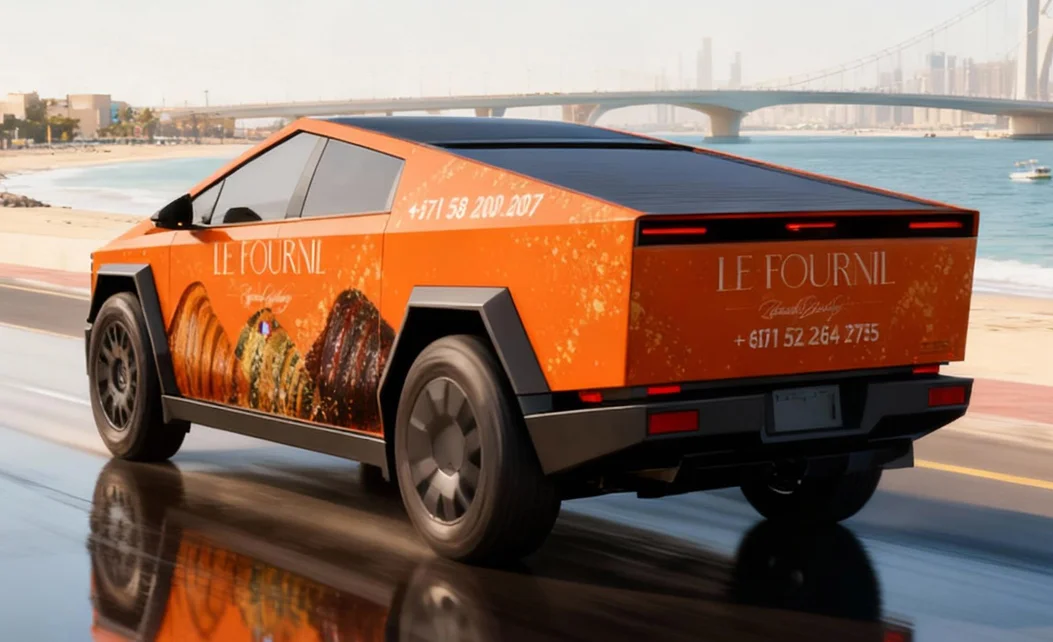
Mistake 2: Getting Color Contrast Wrong
Color contrast vehicle graphics is a topic that designers sometimes underestimate until they see the print on a vehicle in real-world lighting conditions.
A design that looks sharp on a monitor can disappear on a vehicle under harsh Dubai sunlight, or become muddy at night under street lighting.
Common color contrast mistakes include:
- White text on a light background
- Dark text on a dark vehicle base color
- Gradient backgrounds that reduce contrast as the color shifts
- Too many competing colors that create visual noise instead of clarity
The rule of thumb: if you squint at your design and the text starts to disappear into the background, the contrast isn’t strong enough.
High contrast combinations that reliably work include black on white, white on dark blue or red, and yellow on black. If your brand colors don’t naturally create strong contrast, talk to your designer about how to create contrast through outline effects, drop shadows, or background blocks behind text.
Mistake 3: Using Low-Resolution Images and Files
Print resolution for wrap design is one of the most technical aspects of the process, and it’s where designers unfamiliar with large-format printing often make costly errors.
Vehicle wraps are printed at large scale. An image that looks perfectly sharp at the size it appears on your screen may become visibly pixelated when stretched across a door panel or bonnet.
The standard requirement:
- Images should be at least 100 to 150 PPI at the actual print size (depending on viewing distance)
- Vector files (AI, EPS, SVG) should be used for logos and text wherever possible
- Raster images (JPG, PNG) must be supplied at genuinely high resolution, not simply enlarged from low-quality source material
Many clients come to us with logos pulled from their website. These files are optimized for screen use and typically lack the pixel dimensions required for large-format printing. As a result, they won’t produce a sharp, professional finish on a vehicle wrap. Always go back to the original vector source file for your logo.
At Printzone Advertising LLC, we review every file before we go to print and flag resolution issues before they become an expensive problem.
Mistake 4: Ignoring the Vehicle’s Actual Shape and Surfaces
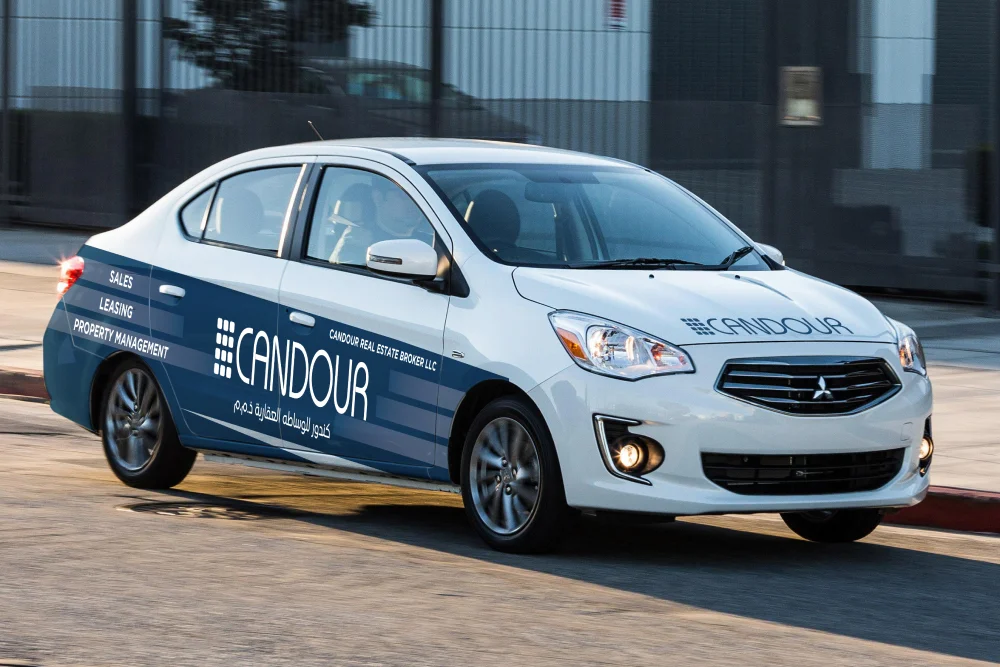
A vehicle is not a flat canvas. It has curves, door handles, mirrors, fuel caps, seams, and recessed areas. A design created in a flat rectangle without accounting for these features will look distorted, misaligned, or broken when applied.
Layout for vehicle branding needs to account for:
- Where door handles and locks sit, so text doesn’t get interrupted
- How curves affect the apparent shape of logos and graphics
- Where seams fall between panels, so important elements don’t cross a seam line
- How mirrors, wheel arches, and other protrusions affect the overall visual
Professional wrap designers work with vehicle-specific templates that map out exactly where these features sit. Designing without a proper template for the exact make and model is one of the most avoidable common car wrap errors, and one that significantly affects the final result.

Mistake 5: Cramming Too Much Information into the Design
Branding visibility on vehicles depends on simplicity, not completeness.
This is the mistake that business owners are most prone to making, because it comes from a good place. You want people to know everything about your business. You want the phone number, the website, the tagline, the list of services, the social handles, the QR code, and the logo.
But a vehicle wrap is not a brochure.
The goal of a wrap is to create recognition and prompt one action, usually to visit your website or call your number. Everything else is visual clutter that competes with that goal.
What a wrap should communicate:
- Your brand name or logo (instantly recognizable)
- One contact method (website URL or phone number, not both)
- A very short tagline if it adds genuine clarity
- Your brand colors and visual identity
If someone needs 30 seconds to figure out what your business does from looking at your vehicle, the design has failed.
Mistake 6: Not Considering Where the Vehicle Will Be Seen
Car wrap design tips often focus on the design itself, but context matters just as much.
Think about where your vehicle actually spends most of its time.
- If it’s mostly parked on busy streets, pedestrians have more time to read it, so moderate detail is acceptable
- If it’s on highways and fast roads, you have two to three seconds of visibility at most, so simplicity is essential
- If your fleet parks in a lot where vehicles are seen side by side, consistency across the fleet becomes part of the visual impact
- If vehicles operate at night, reflective elements and strong contrast matter more
The best wrap design accounts for how, where, and by whom the vehicle will actually be seen. This context should shape every decision from layout to color to font size.
Mistake 7: Choosing the Wrong Wrap Material for the Application
Not all vinyl is the same, and choosing the wrong material affects not just durability but how the finished wrap looks.
Some wraps use cast vinyl, which conforms to curves and complex surfaces more cleanly. Others use calendered vinyl, which is less expensive but less flexible and better suited to flat surfaces.
Using the wrong material for a complex vehicle shape can lead to lifting edges, bubbling, or poor conformity around curves.
At Printzone Advertising LLC, we match the material to the vehicle and the application. The substrate, the finish, and the laminate all affect the final result, and we take that selection seriously on every project.
What Good Vehicle Wrap Design Actually Looks Like
To summarize what separates a great wrap from a problematic one:
- Clean, bold fonts that read clearly at distance
- Strong color contrast in all lighting conditions
- High-resolution vector files for all logos and critical graphics
- A layout designed around the vehicle’s actual shape, not a flat canvas
- Simple, focused messaging with one clear call to action
- Material selection matched to the vehicle type and environment
Vehicle wrap design mistakes are almost always fixable at the design stage. They become expensive when they’re caught after printing or, worse, after application.
How Printzone Advertising LLC Approaches Vehicle Wrap Design
We’ve worked on vehicle wraps across Dubai long enough to know where designs go wrong and how to prevent it.
Our process includes a proper design review against the vehicle template, file quality checks before print, and a pre-production approval stage so you see exactly how the design will look on your specific vehicle before we commit anything to vinyl.
If you come to us with an existing design, we’ll give you honest feedback on anything that could cause problems. If you need design support from scratch, we’ll build something that works in the real world, not just on a screen.


Feel free to leave a comment!
Your email address will not be published. Required fields are marked *